Labels

Sunday, May 5, 2024

Opioid Misery--A Reason to Ride, and Walk, and Fight Back

It looks empty, doesn't it? A small jurisdiction, part rural, part suburban--no special reason to be singled out for suffering. Yet, there was the jury pool off forty four citizens of that small jurisdiction, with eight hands raised. Eight of forty four. They raised their hands in response to the lawyer's question, "Have any of you had a family member or close friend die from an opioid overdose?"

An epidemic of teenage suicide--record levels of  teen mental hospitalizations--sky rocketing levels of self reported anxiety and depression, increases in alcoholism--and underlying all of these headlines is a deep, long lasting and profound unhappiness.

And if you are only looking for someone, or something,  to  blame don't waste my time. If you are looking for solutions--let's talk.

We don't just teaching riding. We teach wellness. We teach hope. And this June I hope that a lot of our program participants learn a lot about hope and their own personal wellness.

"The NMM Challenge"  No Mechanized Movement. it is that simple. Each day in June participants will record, with precision, the number of miles that they rode a horse, walked/jogged, or rode a bike. There are a few other rules but the point is to move. 

And it is very likely that those who win will win several times each month. They won't know it when they win. It might even be years from now that they realize that they won. 

Every morning that they got up extra early to walk four or five miles when they would have rather lay there in bed, is a win. Every time they get on the horse that they fell off of on the last time and ride hard in the heat and the bugs, is a win. Every time they start their bike ride with a bit of pain and stiffness is win. 

Every time they refuse to take the easy way out is a win.

Life in this century in our nation is a constant push toward immediate gratification, rejection of the slightest discomfort, with nearly every significant aspect of our lives, from our cell phones, to our air conditioning working hard to destroy the resilience that we have to have to survive. 

When life becomes nothing but the avoidance of all discomfort, then life becomes the avoidance of living.

It is the struggle, the big ones, and the little ones, that give us the resilience.  To get technical for a moment, it is engaging in the struggle that gives us higher baseline levels of dopamine. It is the struggle, and the willful engagement in the struggle, that allows our neurotransmitters to work as they have evolved to do. Opioid addiction is one of the defaults that we fall into when we gradually decide that we must stay back from the struggle, that we must only do what is easy, that  we must always be comfortable. 

So this June, push yourself. Push your child. Get up and move. 

And don't tell me that it is too exhausting.  Watching children rot is much more exhausting. 


Thursday, April 18, 2024

Home Schooling At Mill Swamp Indian Horses in Smithfield Virginia

 
There has never been a learning experience to compare with the home school program at Mill Swamp Indian Horses. Each Friday from 9-2 students are exposed to a range of topics that on any given day could range from history to philosophy, to wildlife habitat construction, to conservation and preservation of nearly extinct strains of early colonial horses and livestock, to music, to microbial pasture development, to natural horsemanship, all on a farm designated as a certified wildlife habitat.


Students range in age from five years old on up to older teenagers. Full family participation is encouraged. That is why the fee structure is only $100.00 per family per month. Parents may stay and participate in all of our programs. Mill Swamp Indian Horses is a program of Gwaltney Frontier Farm, a nonprofit corporation with no paid staff. Pack lunch, dress to be able to walk in woods and pasture and wear clothes that are great for play--and work. 


Kids participate in helping with special programming like our annual sheep shearing program with our rare, heritage Hog Island and Leichester sheep. They can learn how horses can be used to bring peace to people with anxiety and PTSD by helping with our weekly sessions with patients in the PTSD program at the Hampton Veterans Hospital.


Kids learn solid information on health, exercise and nutrition and come together for special events like our January 1, ten-mile hike in the Dismal Swamp as shown above.
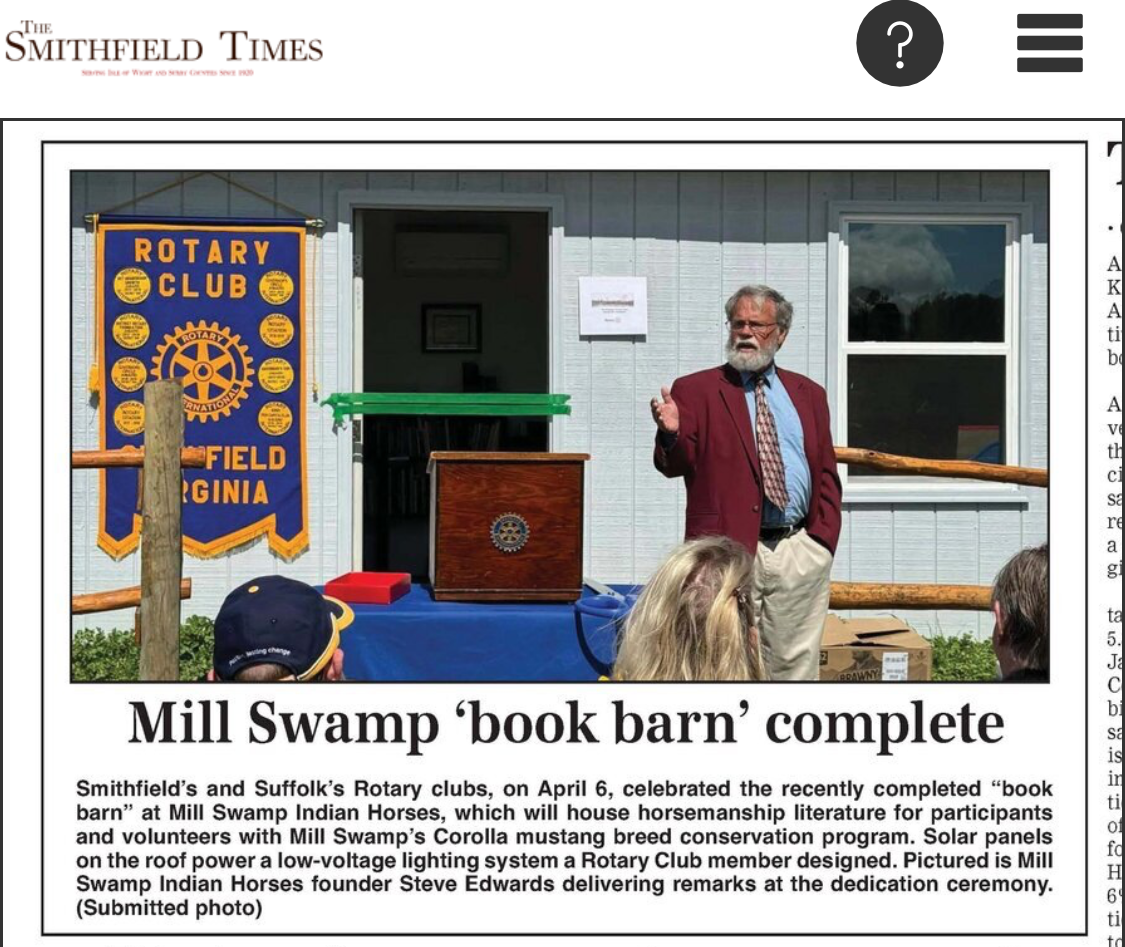
The community has really come together to support our program with the understanding that we are more than just a riding lesson program. We are a cultural and educational institution dedicated to bringing the best of the past into the present for young people today. Our book barn, which stores our educational materials and records, was constructed by, and completely paid for by the Smithfield and Suffolk Rotary clubs.
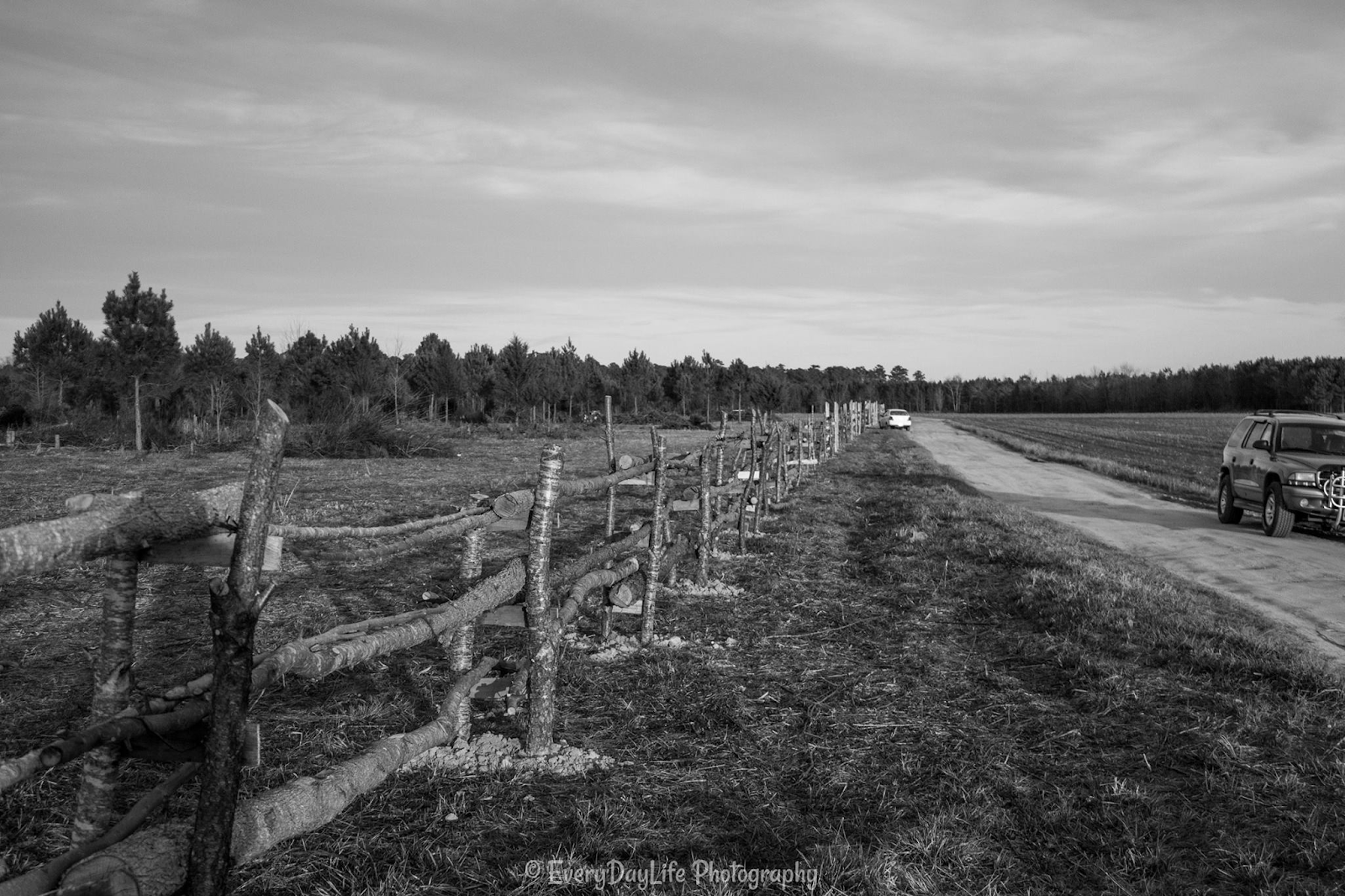
And program participants learn the joy of hard working and working together. Improving wildlife habitat, constructing and repairing fences, planting pastures by hand and clearing land for new forage opportunities- these are a few of the kinds of projects that the kids learn to do and to take pride in
Riding is not the focus of the homeschool program, but program participants learn natural horsemanship. they learn to understand the mind of a horse. They learn that building a relationship with a horse or donkey is the perfect model for using empathy and sound communication skills in building relationships with other people. Natural horsemanship is used to create good horses and better people.


And participants in the Home School Program help with what is one of our major missions, working to prevent the extinction of several strains of historic Colonial Spanish Horses, including the Banker horses whose ancestors arrived in the New World a century before the Pilgrims landed at Plymouth, Choctaw horses whose ancestors carried the Indians of the southeast on the Trail of Tears, Marsh Tacky horses whose ancestors were ridden by Patriot forces during the American Revolution, and the remnant of the Grand Canyon horses. 

And all of this for only $100.00 per family per month. We have never turned a family away for inability to pay program fees. If the program fee is beyond your family's budget you may pay  a monthly fee that is within that budget. To register send an email to msindianhorses@aol.com.


Friday, February 23, 2024

Home School Hugle Kulture With Our Kubota


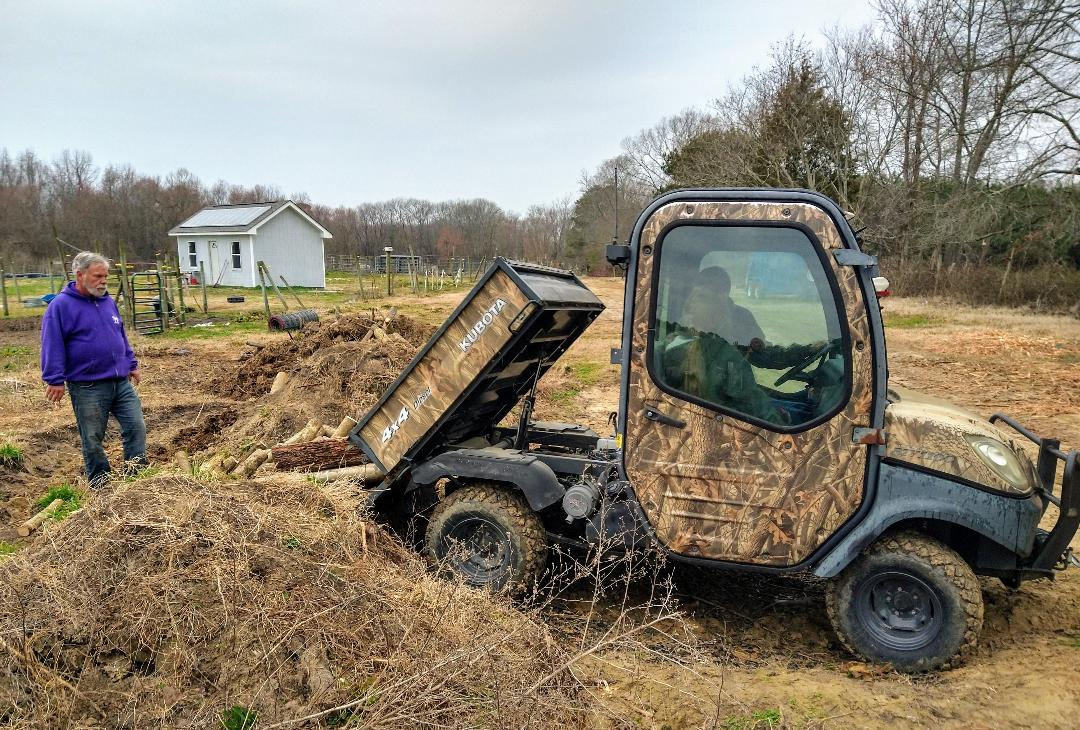
Today was the first day that we could use the wonderful contribution of this Kubota hauling and dumping mobile. This wonderful contribution from Oliver and Linda Brickhouse sped up this spring's work to expand and replenish our huglekulture mounds efficiently and at a much higher level than our past efforts of moving everything by hand.  

We use no poison in our program. We practice microbial pasture development and worm farming. Our vermicompost is a vital element in the mounds that are built from organic material with a heavy emphasis on compost and wood from our forest. We cut fresh logs, load and move them to the mounds, unload them, and go pick up a load of primarily organic soil created from trampled round bale residue. That residue goes onto the mounds which will be capped off with a few inches of topsoil prior to planting. 

Rain disrupted outside activities but still today we were able to put a Corolla mare in with a stallion for breeding, discuss applications of Marcus Aurelius' "Meditations", to life in this century, and have a session on local black history. We wrapped up planning for tomorrow's Heritage Sheep Shearing event. We hope to have a lot of local guests out to learn about heritage sheep, shearing and wool production, and colonial livestock management. 

We might even sell a goat or two. 

There is no learning experience out there like the Mill Swamp Indian Horses home school program. And we have room for even more families in the weekly sessions which run from 9-2. 

And the cost for the homeschool program is only$100.00 per family, per month. To register your family please send an email to msindianhorses@aol.com

Tuesday, January 30, 2024

Alone?

There are few things that I enjoy as much as riding with people that I care about. I generally do so several mornings each week before coming into the office. In the last week 

I fell back into doing something a bit different--something that I have not done much of in years. Riding alone. Riding with the sound of only one set of hooves--being truly alone with one's horse and one's mind is a great way to stimulate creativity. And it is not an "instead of" proposition. It is an "in addition to" proposition.

The simple reality is that if I am going to wrack up the number of miles that I must for 2024 many of those miles will be solitary rides. I don't know how I drifted away from riding by myself but I am certainly going to fall back into the practice to pick up several hundred more miles in the saddle beyond what I have been doing. 

Thursday, January 18, 2024

He Could Not Have Been More Wrong!


And there was a time when I would have enthusiastically endorsed his misperception. 

It was one of those few times when the two major parts of my life--being a criminal prosecutor and being a teacher of natural horsemanship overlap. I have been in a murder trial all week and as I was preparing for my opening remarks I was doing some breathing exercises. Sometimes they can be a bit loud.

Opposing counsel looked surprised and then said, "Oh, you are just psyching yourself up." 

In fact, the exact opposite was occuring. I was psyching myself down. I was going into a deeper state of relaxation that would make me less impulsive and more able to notice everything going on around me. I was slowing down my heart rate and clearing my mind.

 In short, I was doing the same thing that I do when I am confronted with a terrified horse with a training problem. I prepared my body to be under my own control. I put my emotions in my pocket where I could reach in and pull them out only if doing so would be effective. 

 When i was young I ran off of adrenaline and confidence. The two made potent fuel, but they burn too hot to use long term.

I am working hard to teach the kids that I am training now to understand that they must first control their emotions before they can control a horse effectively. It is a concept that matters.

If your horsemanship is not making you a better person it is failing you and you are failing your horse. 

Sunday, January 14, 2024

We Don't Have a Drive Through Window at Mill Swamp Indian Horses


I have been doing this for a long time, long enough so that children who learned to ride, tame, train, and work with me are now grown and often return with their own children in tow. It gives me a special perspective on what matters in our program. It is important to consider what these adults have to say to their children during these visits. 

 It is even more important to consider what I never hear them say. The adults do not speak of the "fun" that they had riding. They speak earnestly of the accomplishments that they made as kids in our program. They talk about the role that they had in training horses with us. They talk about exceeding not only their expectations, but their wildest hopes of what was possible. They speak with great pride of riding in weather that their parents had told them was too hot, or too cold to ride in. They never mention meaningless trophies or ribbons, but they know exactly how far they have ridden in a single day. 

They talk about how their parents did not believe that they could ever achieve the goals that they set for themselves as riders and as people. They talk about the land they cleared. They talk about the trees that they helped remove. They talk about the relationships that they built.

 And they talk about change. They talk about what they were like before they joined the program. They talked about how their fears and persistent anxiety abated. They talk about learning to love working for a goal. They talk about feeling that they are part of something. 

Parents who  have ever had such an experience cannot conceive of it, much less understand it. They see it merely as an "activity" to take up a block of a kid's time. The very worst use of what the program has to offer is to use it simply as a tool to manipulate a child's behavior, e.g. "If you do your chores you can go ride a pony." To do so is to choose the drive through window of a fast-food joint over giving a child a consistently healthy diet. 

 Yesterday we had another workday at the horse lot and like all of our workdays it was sparsely attended, especially by the youngest riders. They missed out on the comradery. They missed out on building social skills. They missed out on the chance to learn that they could do more than they thought they could. 

 They missed knowing what it is like to be seven years old and to put so much of your effort into a physical task that you fall over as you work to rip a tree stump out of the ground with your hands.

Even experienced horse people can miss the point of what we do. They can only see the by-product, not the product. Learning to ride and learning natural horsemanship is the by-product. Building character and teaching kids how to have a life of meaning is the product. Learning courage, honesty, compassion, and generosity is the product. 

 Kids learn that self-discipline is freedom. 

 This morning when I woke up, I found this post on Facebook from the proud father of a young lady who is taking full advantage of what the program at Mill Swamp Indian Horses has to offer: 

 "I want to say for the record how proud I am of my daughter for going out to msih to work on a Saturday that she could have spent any other way. I am impressed that she was up before I was ready to go. Good job Grace!"

Thursday, January 4, 2024

The Temperment Of the Colonial Spanish Horse


There are only a handful of these horses left--some estimates are as low as three thousand. Of those, a much smaller number is trained to saddle. Of that small number even fewer have been ridden by a wide range of riders. 

In short, if you have the privilege to handle, to  ride, or have the extreme privilege to own one of these horses, you already know why they are so special. Endurance, over all health and soundness, ease of handling, smoothness of gaits--all of these things matter--but the older one gets, the more one understands the importance of temperament. 

The good news is that more than any horses I have ever handled these horses focus on, and mirror, the emotions of the human with whom they regularly deal. The bad news, and it can be very bad news, is that these horses focus on and mirror the emotions of the humans with whom they regularly deal. 

Want your horse to be calm and steady?--then become calm and steady yourself. Want your horse to be alert and pay attention to footing problems on the trail, in the woods, or even in the cut over?--then be alert and pay attention to the trail. 

Are you having a problem with your horse?

Well don't blame the mirror.

Tuesday, January 2, 2024

How to Treat Your Family, Your Friends, Yourself and Your Horse


Several years ago, when thinking about what I should do with the rest of my life, I decided to work hard to study the concept of wisdom and to put the same degree of effort into becoming a good person that I put into taming horses. My first thoughts were to look to those that I considered to be the best people that I knew and to seek to define a good character by looking hard at how they conducted themselves. I have always been perplexed at two things that they all had in common--I never heard any of them speak ill of another person and they could each easily catch crazy dogs that seemed terrified of others. Hounds that could not be touched by others seemed drawn to these three men.

 Whenever I share this with others the response is a nervous laugh--they think that I am joking and that it must be a very weak joke. 

 It is not a joke. It was true in each case--but I did not understand it. But this morning I found this quote: "If you become steadfast in abstentions of thoughts of harm directed towards others, all living creatures will cease to feel enmity in your presence." Patanjali, 200 B.C. 

 Of course, whenever training a horse one must first relax one's mind and body in order for the horse to feel secure in one's presence. But there is a deeper level. A horse cannot love a heart that is filled with hate. Do you want your horse to transition better in his gaits, ease over a jump more gracefully, respect your space? Before spending money on gimmicks to create the appearance of change in your horse, put in the effort make real change in yourself. 

 Don't wait for your horse to improve before you can become a better person. Become a better person right now and watch how much better your horse becomes--all by himself--just like magic. 

 Cutting the hatred, anger, resentment, jealousy, and frustration out of your heart creates that magic.

Sunday, December 31, 2023

January 1, 2024 Mill Swamp Indian Horses Is On the Move!

Some people in our program are waking up a bit conflicted. There might even be a few that did not sleep very well. Some people might not have slept well for the past several days. They are struggling. They are struggling to decide whether or not they trust themselves. 

Tomorrow morning many of us are going to bring in the new year with a ten-mile hike in the Dismal Swamp. 

Most of the people in our program have never walked ten miles at a time. Therefore, they do not know if they can do it. And for some, if they do not know that they can do it then they certainly cannot risk finding out. Some might even feel that in this entire world there is nothing worse than failing in front of others.

 But there are things much worse. It is much worse to live in fear of failure than it is to take on a hard challenge. It is much worse to worry about a challenge than it is to learn to push through challenges. Some young people and way too many parents do not understand the import of doing things that are difficult. It is not to prepare one's body to win a trophy. The stakes are much higher than that. It is to prepare oneself for every drop of rain that will fall into everyone's life. 

  Here is the core truth that most people never understand. Doing hard things does not make you stronger. Doing hard things simply allows you to understand how truly strong you are.

Doing hard things prepares you to fight. Doing hard things teaches you that you can fight. Doing hard things does not guarantee that you will win every fight but avoiding doing hard things does guarantee that every fight that you are forced into will be much more difficult if your only preparation for life has been to hide and avoid.

 We leave the tack shed at 9:00 am Monday to drive to the Dismal Swamp for this wonderful hike.

Wednesday, December 27, 2023

"Pain that never sleeps falls drop by Drop on Our Hearts Until, Through the Awesome Grace of God, comes Wisdom"--Aeschylus


She was upset. She was wrong. She told me that I must never let the kids see pain in me. She did not want me to talk about Lido. 

 It is a damn sorry role model that teaches kids that lying to the world is fine as long as you lie to yourself with equal vehemence. 

 On December 29, 2008 my little brother who was 17 years old reached into the truck to take his gun out to kill another deer. He was there hunting with his best friend on what is now the New Land. Cerebral Palsy made it so that he only had one arm to use for the removal. The gun accidentally discharged, and I lost my best friend and my role model of perseverance and resilience. 

 And each fall since then I have careened though life as I moved back towards the date of his re-death. I fight though the calendar as if I were running a marathon. I constantly remind myself that January is coming. 

I stumble though the holidays not as a wounded person, but as a wound. Every slight, every new responsibility dropped on me, every insult, no matter how minor rubs the open wound that is my existence for about the last quarter of the year.

 Over the years the pain has become utterly manageable. But the fear has not. I was sitting at my office when the phone rang --the damn phone--the sound that I hate to hear the most --the most disruptive sound in my existence--the phone that still cuts thorough me every time I hear one ring--to be told that Lido was dead.

 And if Lido could die like that every single soul in my life could leave with equal ease. Never could I be safe in feeling that the person that I love today will be with me ten minutes from now. This time of year, I find myself urging those around me to be careful. This creates friction with some teens. They don't like being asked to make sure that they are riding in a safe, responsible manner. Some of them truly resent it. They don't have the life experiences that allow them to understand.

 But that mother was so wrong when she told me that talking about Lido upset the kids and that I should not do so. She was wrong not because she hurt me, but because she sought to deprive me of the chance to teach the children a very important lesson.

 And that lesson is both this simple and this difficult. The lesson is that, like Lido, I did not give up. I fight back every single year and every single year I make it to January. And it is the hardest thing that I ever do. And I do it. 

 And they can do it too--whatever "it" is. After Lido died Chaz Hornbaker's Eagle Scout project was the building a bridge over the swamp behind the Little House that is dedicated to Lido which is inscribed with his constantly encouraging words, 'If I can do it then why can't you?" 

 The message on that bridge speaks louder and clearer than any noise that will ever be made on a telephone.

(This is a picture of Lido on Sand Creek in one of our clinic's that he and I used to do on natural horsemanship in the years before we had our current program)

Tuesday, December 26, 2023

The War On Wiftiness--Why Training for Endurance Events Matters to You and Your Horse


Working the horse can be more than just a facet of building strong mental and emotional health. It can be the cornerstone of growth. Whether training the horse's mind or the horse's body, success is dependent on the discipline of the trainer. 

 To be "wifty" is to be a person who bounces from one interest to another without even coming close to developing a pattern, much less a well-set discipline of work towards a goal. A wifty person lives whim to whim.

 A wifty person sees a picture of a horse and "falls in love" with it. A wifty person sees a picture of a show rider with a blue ribbon and is pulled, if only for a few moments, perhaps a few minutes, or maybe even a few months towards the show ring. A wifty person is perfectly enthusiastic about the moment's whim and remains steadfast in that enthusiasm until confronted with a need to work, a need to develop a schedule, or a need to prioritize life's demands. 

At that point the wifty person quits. Every single time the wifty person quits they take home one strong message--"I failed." 

Wiftiness allows one to imagine pleasure but to only realize pain. Wiftiness creates slow burning misery.

 Discipline allows one to imagine pleasure and provides a pathway to realize that pleasure. The effective practice of natural horsemanship transforms the imagination of pleasure into its realization. The discipline required to condition one's horse and one's body for endurance riding takes one's equine experience to a different level. The reward that one gets from knowing that one is truly improving the horse's health and happiness by building a strong heart, efficient lungs and a powerful body trumps the fleeting feeling of having someone hand you a blue ribbon or a trophy. 

People often speak of "partnership" with the horse. When the two of you work together to become as strong physically, mentally, and emotionally you two are the closest of partners. 

 Stop being wifty. 

Commit and follow through. 

You deserve better. Your family deserves better. 

Your horse deserves better.

Monday, November 13, 2023

On Finding Meaning: The All Y'All Players

" When we were young we wanted to save the world. Now we are here to help out in the neighborhood," Rick Danko, of The Band once said.

 That was not an admission of failure. It was a recognition of the importance of service to the community.

 Young people often ask me about finding meaning in their future lives. They generally are talking about choices of employment. As important as that decision is, I always remind them that their are many ways to use one's talents off the job to help build a better world. I remind them that service need not be drudgery. The use of one's special interest, and special talents can be fun. The fact that one has fun while being of service to others makes it even better.

 Our program has recently been the beneficiary of an innovative approach to do just that. The "All Y'All Players" are a group of local theater enthusiasts who use their talent to put on murder mystery fun productions with the proceeds going to local charities. I was honored when they offered to make Mill Swamp Indian Horses a beneficiary of their most recent production.

 I loved the invitation to come out and tell the audience a bit about our program before two nights of shows. I loved watching the performances. They have done, and are continuing to do, great work and it is clear from watching that they love their work. 

 Everyone can make a contribution to a better community and when we do that we are making a contribution to a better world. The "All Y'All Players" are doing just that.

Monday, October 23, 2023

                                                         A Home School Mystery


Mill Swamp Indian Horses, in Smithfield, Va is part of a nonprofit breed conservation program that works to prevent the extinction of rare, historic strains of Colonial Spanish Horses along with other heritage livestock. Among its many programs are the weekly Homeschool programs. The program offers unique educational opportunities that promote physical, intellectual and ethical growth for young people (and their parents). Here is a brief description of the events in last week's program. The morning started at 9:00 am with the collection and weighing of organic material that participating families brought in for the program's vermicomposting projects The program, which is a certified wildlife habitat site, uses no chemical herbicides or commercial fertilizers in its pastures. The compostables were added to the 250 gallon container that houses the compost and composting worms. Later in the morning approximately 300 pounds of horse manure was added to the compost. 

 The families then got together on the tack shed porch for a discussion of the impact that the study of philosophy had on the Founding fathers and how Madison's view of the limitations of individual virtue lead to the growth of the two-party system of government in America. The kids then used the boards from an old pallet to paint bits of song lyrics on them to place in and around the pastures. The short lines of lyrics will serve to prompt questions from guests for years to come--e.g. "What song is that from?", "Who wrote that?" "What does that line mean and why is it in this pasture?" 

 With a bit of time on their hands two talented young musicians in the Mill Swamp Indian Horses music program pulled out a guitar and played a handful of songs. 

 As that project was wrapping up the van pulled up from the Hampton Veterans Hospital as it has done weekly, weather permitting, for over eight years. Those who are in the in-patient PTSD program at the Hampton Veterans Hospital come out to learn about trauma's impact on communication, behavior, and trust and to then work a horse in the round pen applying the lessons that are discussed in the beginning of each session. Program participants quickly catch two or three horses and bring them over to the round pen to give our guests an opportunity to meet the horses and brush them down before the program begins. 

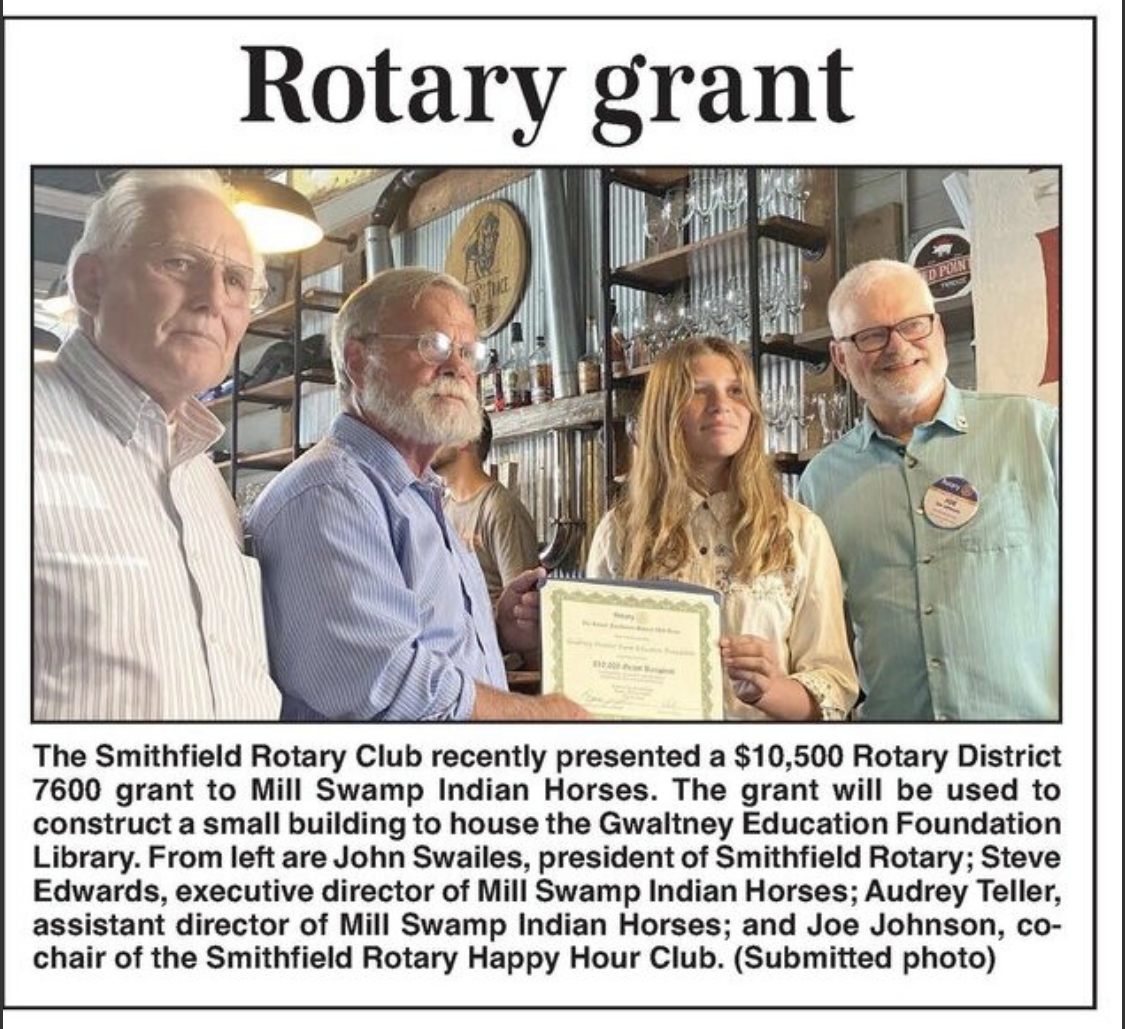
 Support from the community is vital to keeping our programs alive and growing. The Smithfield Rotary Club is constructing a wonderful building to serve as a library to house all of our books and educational materials. Beside that construction is a cement pad for the statue of the Hardy Elementary Mustang that we are having restored. The statue has had a long role in our local history and was donated to us by the leadership of the local historical society.

 Tonight, many of our program participants will be attending a lecture by Dr. Helen Roundtree on the Powhatan Indians who lived here before my family first came over in 1635.

 The homeschool program has to remain flexible because we never know exactly what the day might bring us. A tree might have fallen on a fence, and we might have to spend hours dissecting the tree and restoring the fence. We might need to assist the vet who is coming over for shots and dental work on the horses. We might be surprised by the birth of a calf, lambs, or goat kid and need to move some of the livestock around to get the best use out of our pastures. 

 Our last session required a big adjustment in plans and tremendous flexibility. We had been invited by the PTA of Hardy Elementary School, whose mascot is a mustang, to ride a couple of mustangs in the home coming parade. The invitation came about 72 hours before the parade. I was joined by Audrey Teller, mounted and in costume, for the parade. The other program participants helped us get the horses together, tack up, get trailered and then walked along with us on the parade route--keeping an eye out for any potential danger that could come up on the parade. I knew that I could count on them to remain focused and ready to step in in case something spooked a horse or if a child ran out from the sidewalk in uncontained excitement at the sight of two beautiful Colonial Spanish horses--one a former National Pleasure Trail Horse of the Year for his registry, and the other a formerly wild horse from Shackleford Island who recently completed the prestigious Old Dominion 55 Mile Endurance event. Those who walked along with us have used their time in the program to learn to train horses to saddle and have joined in on group rides, including 7:00 am morning rides in the woods before I have to get into the office. These kids, most younger than fifteen years old have already learned principles of natural horsemanship that give them better understanding of the mind of a horse than most lifelong horse owners. 

 And all of these programs (and I have barely scratched the surface of the range of programs that we have) are all carried out with no paid staff. that is why we can offer these programs for only $160.00 per family, per month. 

 Which leaves us with a big mystery. We have room for many more homeschool families in our program. What is holding other homeschool families back from giving their kids one of the most significant opportunities for growth that they will ever have? 

 Perhaps it is because people do not know how to make the initial contact--if so, send me an email at msindianhorses@aol.com and we will arrange a time for you to bring your family out and see how we do things

Thursday, October 12, 2023

When the Community Is With You

We could never do the range of programs that we have without the enthusiastic support of the community. The Smithfield Rotary Club not only gave us this large contribution to fund the construction of a building to house all of our education materials, they are even supplying the expertise and the labor to get the "Library" constructed. 

The building will house our records and memorabilia and the educational material that we use in our program. That will include books on microbial farming, music, history, horse training, livestock conservation, and philosophy and other topics that we will be teaching in the future. 

As it stands now these books and documents are in several different houses and are not accessible to program participants. This will change all of that. 

 I want to begin to highlight more the contributions that we receive from community organizations. Those contributions matter. They keep our program growing and they keep our volunteers encouraged.

 And they are deeply appreciated.

Wednesday, October 11, 2023

When Is Our Next In House Endurance Event?

Young people have a hard time understanding it, but our next in house endurance event is today, tomorrow, and every day that I can make it happen. We will have the event just before Turkey season comes in in the spring--likely early April. But that event itself is a bit anticlimactic for me. I love the preparation--the conditioning--the honing of my horse and myself. I love the feeling that riding when I don't feel like riding gives me. I love the freedom that self discipline gives me. 

The event itself will be great. The best part of that will be watching riders demonstrate their increase in riding skills--especially kids and new riders. I love watching how much better horses move when their bodies are rock hard from months of conditioning. I love seeing healthy horses and no horse is healthy unless it is well conditioned.

 Endurance work is the only kind of equine competition in which I have any interest. It is the only form of equine competition that I know of that has been good for the horse. And conditioning a horse is spectacular exercise for the rider. The increase in balance, and core strength that comes from spending hundreds of hours in the saddle is a great benefit to older riders.

 But most of all, it is the self discipline that is needed to get up early, morning after morning to ride that transfers over to every other challenge in life. Where one finishes compared to other riders is of great interest to younger riders. I am not being condescending when I say that. Twenty years ago it would have been of great interest to me. I stopped competing against others years ago. Now I only compete against myself and endurance riding has made me a very worthy opponent of myself. For me the formal event is desert--likely a wonderful desert--something that I really enjoy--but not sustenance for for living.

 Training and conditioning are my main meals--they keep me growing--even at my age.

Tuesday, October 10, 2023

Why?


Why is it worth it to put so much time, effort and money into our program at Mill Swamp Indian Horses? It is because of days like today. I showed up in the dark this morning to find other riders already here for the rides that we do before I go into the office during the week. We had fourteen riders today. As the sun came up we set out on Corollas, Shackleford, Choctaws, a Spanish mustang, Horses of the Americas, Grand Canyon lined horses, a Marsh Tacky, a Marsh Tacky/Rocky Mountain cross, half Chincoteagues, and even a Tennessee Walking horse. 

As the sun rose we headed into the woods with four riders in for their first morning ride, three mothers riding with their children, me and Terry and three very experienced teen riders. 

 I love the ride. I love being able to provide this experience for families in our program. I loved seeing the horses working so flawlessly together. But the best thing is what I got to see this morning--I got a chance to see kids grow--and grow very fast. I watched confidence being earned and being applied. I watched parents and experienced teens teaching and encouraging those with less experience. I watched effective intergenerational communication.

 I watched kids not merely learning, but loving the experience of learning. I have been doing this long enough to know that this morning I had the privilege of watching life changing events. There are very few old men out there who had that privilege this morning. 

 That's why.

Best Book For Horse Trainers?

This is an easy question. I often see people arguing about which celebrity clinician they follow. Some people get nearly religious about it. They have found their training savior, and they try to warn others of the heretics out there who do not preach the true gospel of natural horsemanship. 

 Just about any person experienced in natural horsemanship can sufficiently teach the basic techniques of the art. Ray Hunt and Dorrence, to my eye, had the best ability to comprehend and explain the concepts that underlie natural horsemanship. I have learned from many great trainers over the years. However, for the people who have seen the techniques demonstrated countless times and have heard all of the concepts that are the underpinning of natural horsemanship, yet still find themselves disappointed in the results that they get with their horse, there is one writer that I would go to every time, Ryan Holiday.

 Specifically, his great work, "Stillness is The Key". 

 When one knows the techniques and the concepts and is tempted to blame the horse, that is the time to rush out and buy each book that Holiday has written. Of course, these books only mention horses in passing, if at all. They are not horse books. They are people books. That matters--it is very rare for the problem to be a horse problem and it is mind numbingly common for the problem to be a people problem. 

Holiday's scholarship forces the reader to confront one's own vast range of "people problems." Consider this from "Stillness is the Key": 

 "So much of the distress we feel comes from reacting instinctually instead of with conscientious deliberation. So much of what we get wrong comes from the same place. We are reacting to shadows. We are taking as certainties impressions we have yet to test. We're not stopping to put on our glasses and really look." 

 Yes, that is it. That is why you do not have your horse under control. You must first get yourself under control. You must control your emotions and instincts before you can expect a horse to abandon his instincts and put his life in your hands. 

 Ryan Holiday's works teach how to achieve that goal better than anything that I have ever come across.

Easy Things To Find

A firm rope halter--now that can be hard to fine. Western girths without tongues--I can't help you find one of those. Fly spray that actually works for a four hour summer ride through the woods--Nope, can't find that either. 

 Many other things are not as hard to find. In fact, it is hard to avoid fining them. They will come at you. They will seek you out. 

In the horse world one will never have any problem finding someone to tell you that: 1. You and your horse are just not a good fit. 
2. Your horse is too young or too old to train.
3. Your saddle does not fit. 
4. Your horse seems a bit "off" today. 
5. Your horse is too small for you. 
6. Your horse needs to be evaluated by a specialist who can tell you why you fell off when he spooked. 
7. Your horse needs whatever supplement that they give their horse. 

 In fact, I only know of one way to avoid such people. Get on your horse and ride. Ride long and ride hard. Ride your horse enough so that both you and your horse are in good shape. Keep moving. You are not likely to find these experts actually riding.

Monday, August 21, 2023

                                                          Boot Scoot 'N'---Part of Our Team            
Our program is multifaceted and we have no paid staff. Everything that we do is done by volunteers. On rare occasions we have to reach out to professionals for service and products that we cannot produce in house. I work hard to keep those occasions to a minimum, but there are times when I run into situations way beyond my field of expertise.

 Daddy is a trained farrier and blacksmith. I have never made shoes and it has likely been nearly fifty years since I have put a shoe on a horse. All of our horses are barefooted, and we use trimming techniques rooted in the teachings of Pete Ramey. This summer Audrey and I participated successfully in the Old Dominion Endurance event and are getting ready to go out this week to the Iron Mountain Endurance event. 

 Such events require safe, reliable hoof protection, and that is where Morgan Reid came in. She is a firefighter, a farrier and Hampton Roads Scoot Boot Dealer. I knew nothing about hoof boots except that we had a very short deadline coming up to get well fitted hoof protection on the horses. Other options fell through before I heard of Morgan Reid and Scoot Boots. She came out, explained the boots and fitted the horses for a set. It turns out that Colonial Spanish horses have another trait that separates them from many modern horses. Holland was born wild on Shackleford Island and has incredible hooves, but those hooves are small compared to most modern breeds. Joey is a gaited Choctaw and his gaitedness has had an effect on the overall shape of his back hooves. The hooves are not defective, but they are not typical of what one would find on a Quarter horse. Morgan put in a rush order to get boots that would fit Joey and came out early to get them on him. 

The boots took us through the Old Dominion event where we came in around the middle of the pack, successfully completing a fifty-five-mile ride on horses who had never before seen a mountain on trails that were so rocky that until doing so, I did not think any horse could trot on. Morgan wanted to know how the boots worked for us and even though we completed the ride with the boots still intact, she wanted to try another style boot on Joey to seek an even better fit. She did so at her own suggestion at no extra cost. She made another trip out last week to upgrade the boots to make them even more secure. Again, at no extra cost. 

 The Scoot Boot product is great. Morgan Reid is a skilled professional. Those two things matter. But there is something about this experience that matters more than either of these things to our program. She was more than simply a vendor. She was more than simply a skilled professional. She became part of the team of people who make things happen at Mill Swamp Indian Horses. It is often, and accurately, said that there are no other programs with the scope and breadth of what we do at the horse lot. That is true because we have so many people who go the extra mile to make everything possible. Morgan Reid and Boot Scoot 'N' went that extra mile for us. You can find her facebook page at https://www.facebook.com/profile.php?id=100093720715080

Monday, August 7, 2023

What Is So Different About learning to Ride at Mill Swamp Indian Horses?


Its more than the miles in the saddle. 

It is the time spent in the woods. It is the time spent working together to fence in new pastures. Its the time spent planting. It is the time spent making organic fertilizer. It is the time spent discussing history and philosophy.

It is the time spent carding wool. It is the time spent laughing. It is the time spent learning to love learning. And for many of the kids in our program it is the time spent learning ancient songs on ancient instruments.

Our music program is a big part of what makes Mill Swamp Indian Horses a unique cultural experience.  Kids learn natural horsemanship to better communicate with horses--which inevitably leads to better communication with people. Kids learn music to more effectively communicate with an audience--which inevitably leads to  improved communication with all those around them.