Labels

Sunday, May 8, 2016

Horses Of The Western Frontier


It is easy to forget that there was a time in our history when the western frontier was near the Atlantic and Gulf coasts.

Here are decendents of the first horses to come to the New World in the 1500's.

From Top to Bottom:

Croatoan--Corolla
Red Feather--Corolla
Twister--Choctaw
Hickory Wind--Marsh Tacky
Wanchese-Shackleford


Preserve The Corolla Colonial Spanish Mustang: Reserve Your 2017 Foal Now


The Banker strain of Colonial Spanish Horse is nearly extinct. These historic horses descend from those brought to the southeast by the earliest Spanish explorers in the 1500's. Life on the Outer Banks of North Carolina isolated them from the influence of other breeds. In the 18th century "Chickasaw Horses",(a term for Spanish horses who were bred by the Indians of the southeast) were introduced to the area along with a smaller version of the Banker,called the "Seminole Pony".

In the early 20th Century over five thousand wild Bankers ran free on the Outer Banks of North Carolina. Today only two herds remain, the Corollas and the Shacklefords, totaling less than three hundred wild horses in all.

Mill Swamp Indian Horses  is a program of Gwaltney Frontier Farm, Inc, a 501 (c) 5 breed conservation nonprofit organization in Smithfield Virginia. We are all volunteers with no paid staff. See our website at www.msindianhorses.com and take a look at our Mill Swamp Indian Horses group face book page for more information on our program.

One of our most important goals is to promote the development of additional off site breeding facilities for these historic horses. The development program is simple. If one acquires a colt from our program one agrees that he is never to be gelded and will be made available for breeding at no cost to other mares in the offsite breeding program. If one obtains a filly from our program one agrees to seek, over the lifetime of the horse, to produce at least four foals from a stallion in the program and to seek to place any foals that they do not keep with another breeder who will agree to the same terms for that foal.

Under the appropriate circumstances we might even be able to donate adult horses to someone interested in setting up an offsite breeding program. All off spring produced by the program are to be registered with the Horse of The Americas Registry.

The Corollas have been reduced in number to the degree that they face genetic collapse and sterility. For that reason we are bringing genetics back into these horses that have been lost over the years. No modern breeds of horses are used in the program.  To build our breeding foundation we breed Corollas to other Bankers from the Island of Shackleford. We are also beginning to breed Choctaws to the Corollas. Eventually I want to bring in some Marsh Tacky lines. Stepping outside the box a bit, we are also bringing in a line of Grand Canyon Colonial Spanish Horses that descend from Barbed Wire who is shown in the top picture. He is phenotypically more similar to Bankers than any other  Colonial Spanish Horse strain that I have seen.

The off spring of these horses provide the foundation stock who are then bred to pure Corollas. Out crosses are kept to a minimum as the program develops.

Over the years we have placed horses in the breeding program in a handful of other sites. We now have sufficient diversity in our breeding foundation to work to aggressively expand the program. Last summer we produced a beautiful colt and a flashy filly. Both are now owned by pople who will use them to preserve the strain for years to come.

This spring and fall we are making the following crosses:
1. Three Corolla/Choctaw crosses with three different Corolla stallions
2. Two Grand Canyon/Corolla crosses.
3. Two Shackeleford/Corolla crosses.

So in 2017 we will likely have at least five foals produced for the program. Don't make this a last minute, hasty decision. Begin to consider no whether you would like to reserve one of these foals and begin to develop a small scale, affordable program to help prevent the extinction of the Corollas.

You will not get rich doing this. You likely will not break even. But you will be part of the effort to save a line of extraordinary horses.

Contact us at msindianhorses@aol.com for more information.


Friday, May 6, 2016

Of Course He is Going To Live


Last fall Daddy began to experience pain that was new to him. It worsened and after months of testing he had spinal surgery.

He is recovering nicely and I expect him to be back at the horse lot soon.

Breeding To Our Stallions:Saving Yesterday's Horses For Tomorrow's Rider's


There is a very easy way to get a first rate horse and to increase awareness of several nearly extinct strains of historic Colonial Spanish Horses. Crossing our stallions with modern breed mares has produced several first rate horses. These crosses are not used in the Corolla offsite breeding program because we do not allow any modern horse blood in that conservation effort.


However, breeding to modern mares has produced a string of beautiful, athletic, gentle natured horses perfect for the trail and as family horses. Nearly all offspring from our stallions can be registered with the American Indian Horse Registry.

We do not emphasize breeding to outside mares but this can be a great way to go with the right mare. Here are pictures of a horses from these crosses.

Monday, May 2, 2016

Teaching the Horse To Cross Water


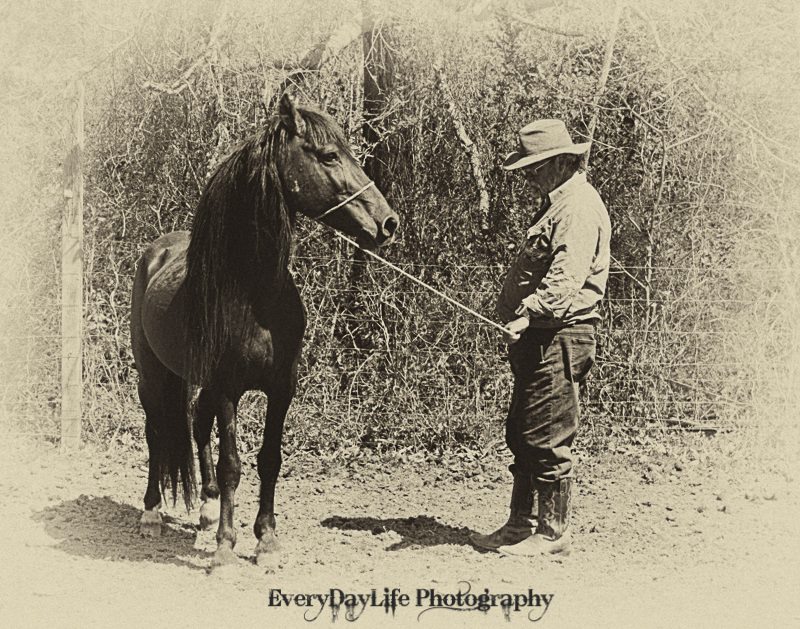
Recently I got an inquiry concerning how to teach a horse to go through water. There are many ways that this can be done. Different techniques work with different horses, but the same teaching principles apply to every horse.

Too often our quest for "how" causes us to forget the essential "why's." My first exposure to natural horsemanship confused me because I wanted a list of directions instead of being told to learn to see things as the horse sees them. My answer might frustrate the person who asked how to teach horses to cross water but it is the best answer that I can give.

1. Turn the noise down. If frustration causes you to view the experience as failure on the part of either you or your horse you will send out body language signals that teach the horse that water is a place of stress and tension. Let your body relax as you approach not only the water but the entire training session.Shoulders down, no eye contact---breath in synchronicity with the horse. When the horse fails to go in the water remain absolutely calm.

2. Apply pressure and release with 100% consistency. A horse that is lead to water, pulled towards it with a rope halter who then balks or rears, only to find that the pressure is released when he does so is quickly being taught that when one approaches water one is to balk and rear. Start out away from the water. Lead the horse with gentle pressure and release the pressure the millisecond the horse begins to consider thinking about the possibility of going forward. Escalate pressure until he does so. The amount of pressure used is not nearly as important as how quickly that pressure is released when compliance begins.
     Reward the horse with instant affection for his effort to comply. Give him five or six black oil sunflower seeds along with that affection. In short, teach the horse which behavior is sought. Sounds simple but this is where most people fail in training. When pressure is released for bad behavior one teaches bad behavior. When pressure is not released for desired behavior one teaches the horse that he is helpless to control the pressure put on him and compliance is irrelevant because regardless of his actions the pressure remains.

3.  Set aside an entire day to teach without any interruptions. I would lead the horse to the water and encourage him to follow me into it using only a rope halter and some sunflower seeds. Pressure and release. Approach the water as closely as possible. Encourage him to go 2 inches closer than he did on the last try--release and reward when he does.

4. We often use the horse's desire to be part of the herd to teach him to be comfortable in water by riding the balking horse in a line with ten or fifteen horses who enter the water without pause.

5.  We have one huge advantage over others with water issues. We have a section of trail about .3 miles that is submerged most of the year. Water depth ranges from less than an inch to about 30 inches.  When a horse begins to cross water, albeit reluctantly we ride through that trail with several other calm horses.

No gimmicks or tricks--simple 100% consistency with pressure and release and an understanding of herd dynamics, joined with absolute self control of emotions and a willingness to stand in a swamp for hours if that is what it takes to make your horse relax.

As I read over this I strongly suspect that others will think that this is too hard and that if one tried this technique or that technique the horse would hop right in. Maybe most horses would. That is not how we teach. I am not critical of others who have found success using other methods but if a technique does not lead me to better understand the mind of the horse than I have no use for it.

Here is the most difficult thing for most people to accept. When I teach a horse having the horse achieve the goal is only half of the mission. If the experience has not made me a better person--more kind, more gentle, more of a leader,  more patient and more in control of my emotions than I have little use for the technique.